


Show all results...

Generic selectors
Exact matches only
Search in title
Search in content
Post Type Selectors

menu

menu

menu

shakespeare's heartbeat

Engaging students on the autism spectrum

“There are many theater programs out there, but few that focus on the specific needs of our Autistic students. Shakespeare’s Heartbeat is designed for my kids. There is no other program in the city that reaches my kids the way that Joe and Evan are able to.”

     – Marissa Ellison, Marina Middle School

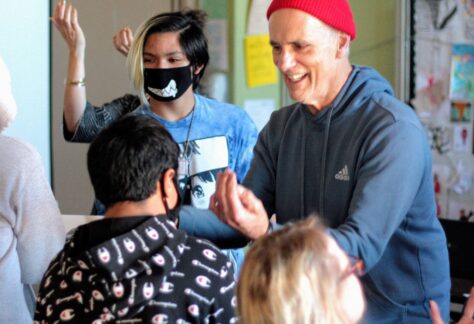
Shakespeare’s Heartbeat is an innovative arts curriculum that uses the heartbeat rhythm of Shakespeare’s iambic pentameter along with the characters’ physicality and the plays’ poetic language rooted in emotion to bring arts enrichment to neurodiverse students. This hands-on programming provides arts access to students who may not otherwise have the opportunity to engage in a performing arts curriculum. In this creative practice, theater games target skills such as kinesthetic awareness, turn-taking and facial emotion recognition to strengthen students’ ability to interact with others and promote social and emotional learning and growth.

Shakespeare’s Heartbeat offers students a weekly structured time to investigate the arts, interact as a community, and develop social emotional skills. The joyful, community-based nature of the performing arts also provides teachers with a powerful educational tool that naturally lends itself to addressing the “whole child” in the classroom. Additionally, the plays themselves offer opportunities to sensitively engage with issues students are confronted with, such as questions of self advocacy in The Tempest and articulating emotion in A Midsummer Night’s Dream.

Shakespeare’s Heartbeat is designed to not only increase students’ cognitive and verbal abilities but actively develops confidence and self-esteem through helping students overcome barriers to interpersonal connection. Festival staff collaborate with school-based teachers and administrators to modify programming in order to best suit the needs of individual students and classrooms. This included adapting curriculum to online programming during the pandemic and fostering parent and caregiver participation. The locations that partner with Shakespeare’s Heartbeat are under-resourced schools with limited arts access and challenging academic environments.

Program History

Shakespeare’s Heartbeat was brought to the Festival and supported by Joseph Schmitz of Eureka Street Learning, with the curriculum based upon the Hunter Heartbeat Method by Kelly Hunter of Flute Theater fame. Beginning in special day classes at Francisco Middle School in 2017, Shakespeare’s Heartbeat continued to serve this community through the pandemic, additionally expanding to three San Francisco Unified School District middle schools: Aptos, Marina, and Everett.

Program ImpactWith Shakespeare’s Heartbeat, we approach district goals and standards through specialized curriculum and a focus on addressing the core social and communication challenges faced by neurodiverse students. The curriculum introduces students to the theater and utilizes performance to gently exercise social and communication skills that children on the spectrum struggle with, such as making eye contact, spatial awareness, personal space and boundaries, reading faces, and expressing feelings. This approach has been shown to improve skills that can increase neurodiverse students’ ability for connection, interaction and self-expression. Through this work addressing arts integration, social emotional growth and equitable practices, we align with our district’s Arts Plan.

Our anticipated program outcomes for students include increasing cognitive competence; developing self esteem, self-expression, and communication skills; improving social competence through cooperation, and collaboration.

Shakespeare’s Heartbeat uses the Hunter Heartbeat Method developed by Kelly Hunter of Flute Theatre, utilizing the iambic pentameter (heartbeat rhythm) of Shakespeare’s words and the physicality of his characters to engage with students on the autism spectrum. Geared towards grades 4-12, this program’s interactive games and gestures are paired with short phrases from Shakespeare’s works to improve social skills, kinesthetic awareness and help with identifying and expressing emotions.

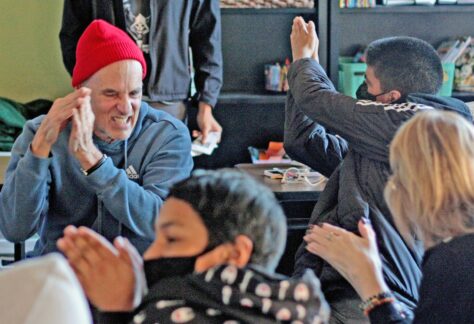
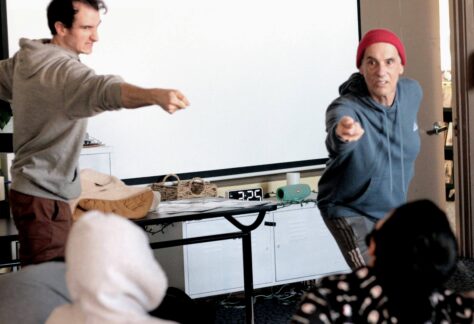
Each class begins and ends in a circle with students and teachers alike tapping their chest to the heartbeat rhythm, saying “Hello” or “Goodbye” to each individual in the group. This rhythm calms and grounds the group in preparation for the games to come. After the Hello circle, many facial expressions are ‘thrown’ back and forth, from a lead teacher to the rest of the group, to explore what best makes us human. The students will then play a variety of games tailored to their specific classroom needs, building crucial social skills such as eye contact, awareness of other people’s emotions, conscious use of our bodies within a group space, turn-taking, accepting loss and failure, celebrating our victories, and the joy of collaboration.

San Francisco Shakespeare Festival is thrilled to partner with Francisco Middle SchoolEverett Middle School, Marina Middle School and Aptos Middle School of SFUSD, the College of Adaptive Arts at West Valley College in Saratoga, and Joseph Schmitz of Eureka Street Learning to present Shakespeare’s Heartbeat. We show eternal gratitude to Kelly Hunter of Flute Theater for pioneering this approach to working with a community on the spectrum.

For information about having this program at your school, contact us at education@sfshakes.org or 415-558-0888

Our Favorite Games

Puck’s Magic Hand
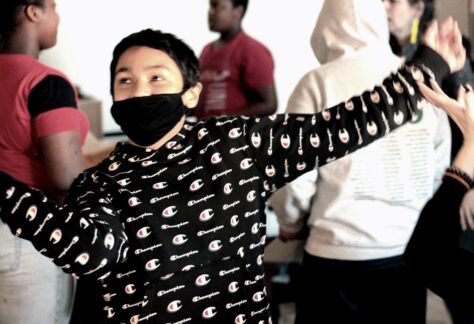
Featuring the magical trickster Puck, this game involves one player “hypnotizing” a student by placing their hand a foot or more in front of the student and slowly moving it around the space. The student’s role is to follow the hand wherever it goes, practicing focus and kinesthetic responses to real-time movements. Students also have a chance to play as Puck, and learn to take care of their scene partners by choosing slower, easy to follow movements.

I Love Thee
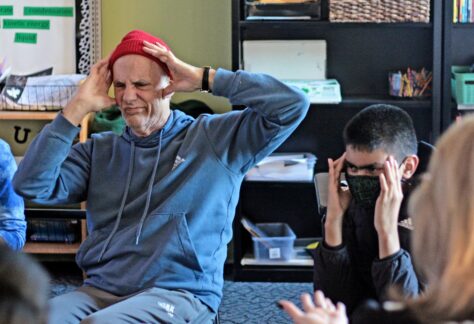
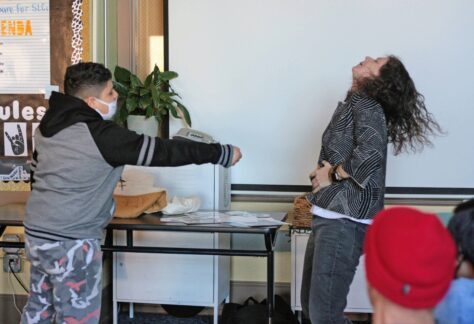
This game features two magical characters from A Midsummer Night’s Dream: Bottom and Titania. At this point in the story Nick Bottom has been turned into a donkey, so students start by practicing a donkey face with hands above the head to represent ears, and making a “hee-haw” donkey sound. Students also practice playing Titania the Fairy Queen, who has had a magical spell cast upon her. The first thing she sees when she wakes up, she falls in love with, which just so happens to be Bottom the Donkey! Titania will find Bottom’s eyes, claim “I Love Thee”, and Bottom will look away, embarrassed, before finally accepting the love he deserves. This game reinforces comfort within eye contact and asymmetrical emotional/physical responses.

Pericles and the Fisherman
This game features the Greek hero Pericles. Running away from an evil King, Pericles finds himself awash at sea with no hope until a Fisherman rows up to him. The Fisherman casts a net, hoping to catch a fish, and instead catches Pericles. After a fun round of imaginary tug-of-war, the Fisherman realizes he has Pericles in his net, he helps his new friend aboard. This game helps students practice reciting lines along with motions, and physical responses in tandem with a partner.


Endorsements

Teacher Natalia Ceníseroz from Francisco Middle School comments “It’s been great working with SF Shakes to find the different ways that we can reach each of our students in their own way. Students really engage with their beloved Shakespeare’s Heartbeat instructors, and are excited and look forward to class. The Heartbeat teachers come with a curriculum and have everything prepared for you. They’re there with you and make it a collaborative experience.”

Teacher Ann Caimi at Everett Middle School reports, “Shakespeare’s Heartbeat has been such a gift to my class. At first, I thought it would be a cool way to spend an hour a week. What it turned into was so much more! After Shakespeare’s Heartbeat, my students can compare anime villains to Próspero in ELA class, and can throw their angry faces away in favor of their focused faces during math tests. My students love this chance to try new things and as a teacher I relish the chance for them to thrive in new and different ways. But the best part is how they connect their Heartbeat work back into all our other subjects and to their own lives.”

Teacher Marissa Ellison of Marina Middle School says “Since the beginning of the year, my kids have grown to view theater as a vital part of our school day. I don’t know that they realize how lucky they are to have this opportunity! We have seen them progress in so many ways. Students who normally need encouragement are now jumping up to be involved in the games and asking to play certain parts. We have seen progress in communication, even seeing one of my students using his AAC device to sing the “Hello” song.”

Shakespeare's heartbeat
Kelly Hunter

Kelly Hunter, creator of the Hunter Heartbeat Method, talks about her victories with the program.

Shakespeare's heartbeat
Joe Schmitz

Joseph Schmitz talks about how the rhythm of Shakespeare’s Heartbeat and how it engages students and staff alike.

Shakespeare's heartbeat
Hunter Heartbeat Method

Kelly Hunter interviewed about the Hunter Heartbeat Method at it’s inception.

Teaching Artists

Joe Schmitz headshotJOSEPH SCHMITZ
SF Shakes teaching artist and autism theatre specialist Joseph Schmitz brought the program to SF Shakes and continues help the heartbeat program flourish. In addition to being the founder of Eureka Street Learning, he works in technology, education, and theatre. When not making video, writing, or acting, he has the pleasure of teaching improv and video-making. He is a co-founder of Special Focus, a performing arts program for special education students in Northern California.

EVAN HELD
Education Workgroup member and teaching artist Evan Held is taking lead on SF Shakes’ side of the program. In addition to managing and administrating, Evan teaches the program with a very hands-on approach. This program is very personal to him, and he believes that by helping the students you also help everyone around them in their lives. “The parents, siblings, and teachers all feel the ripple of the impact of this program”

AL NIOTTA
Al (they/he) holds a Bachelor of Arts in Theatre from SF State University. Al takes their passion and wit into every role and classroom. Equipped with an affinity for Shakespeare, the arts, and good timez, Al has made a home in several of SF Shakes’ education and community programs. Much of their professional journey prior to Shakes has been in youth education, theatrical arts, and outdoor recreation, with employers such as SF and Oakland USD, the GGNRA and MTC, as well as Americorps and the National Park Service. Al aims to cultivate a creative and welcoming space (cause that’s where the best stuff is made).

Jules Simons - headshot

JULES SIMONS
Jules (she/her) is thrilled to join the Heartbeat team this year. She fell in love with working with the disabled community as a camp counselor for EasterSeals Wisconsin and is excited to see the convergence of that work with Shakespeare. Jules believes everyone has a performance in their heart and seeks to create an environment where all people feel empowered to share that.

supporters

Tah-Dah-logo

TAH DAH FOUNDATION
The Tah Dah Foundation is committed to holistic arts education and helping to cultivate critical thinking, cognitive empathy, mindfulness, emotional intelligence, communication, collaboration and confidence for hundreds of children. 100% of the donations received directly support these programs..


CALIFORNIA ARTS COUNCIL
The California Arts Council‘s mission is in strengthening arts, culture, and creative expression as the tools to cultivate a better California for all. They hope to see a California where all people flourish with universal access to and participation in the arts, valuing Community, Accessibility, Aesthetics, Autonomy with Accountability, Relevance, Equity, and Sustainability